Sustainability Mission
Every pallet we recycle is a vote for a healthier planet. Our zero-waste operations keep wood out of landfills and carbon out of the atmosphere.
Go Green With Your Pallets
Request recycled pallets and make a measurable impact on your company's carbon footprint.
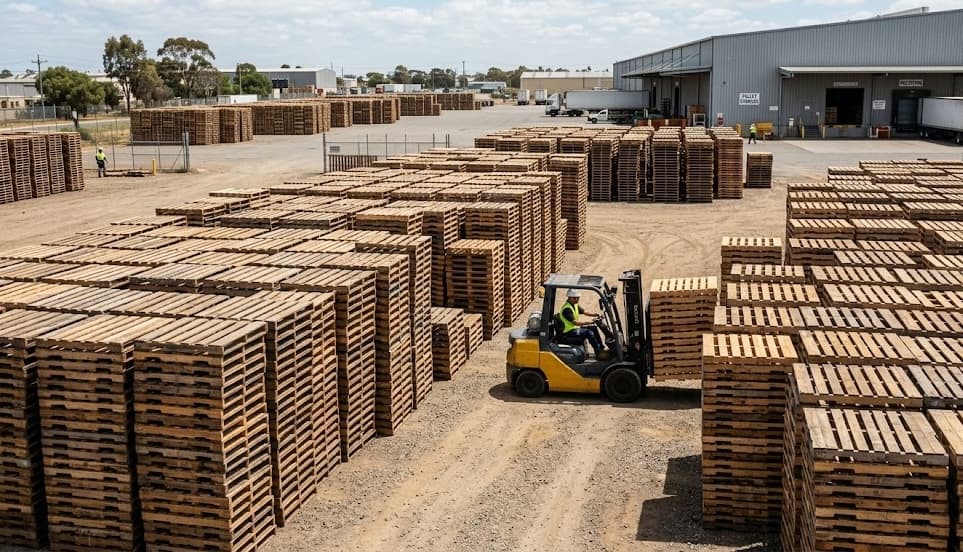
Our Environmental Impact
Real numbers from our operations, tracked and verified every quarter.
8,400+
Trees Saved Annually
By recycling pallets instead of manufacturing new ones, we prevent thousands of trees from being harvested each year.
1,200+
Tons of CO₂ Prevented
Recycled pallets produce a fraction of the carbon emissions compared to manufacturing from virgin lumber.
0
Pallets to Landfill
Our zero-waste process ensures every component is reused, repurposed, or converted into a useful product.
60%
Less Energy Used
Repairing a pallet uses roughly 60% less energy than manufacturing a new one from raw timber.
The Circular Economy of Pallets
The concept of a circular economy is simple: design waste out of the system. In a linear economy, raw materials are extracted, products are manufactured, used, and then discarded. A circular economy closes that loop by keeping materials in use for as long as possible, extracting maximum value before returning them to the production cycle.
Pallets are one of the best examples of circular-economy principles at work. A well-built wooden pallet can cycle through multiple users, be repaired several times, and when it finally reaches the end of its structural life, its wood can be repurposed into dozens of secondary products. At SD Re Pallet, we have designed our entire operation around this philosophy.
When a pallet arrives at our facility, it enters our six-stage quality process. Pallets in good structural condition are cleaned, inspected, and graded for resale. Pallets with minor damage are repaired: cracked boards are replaced, loose nails are re-driven, and any structural deficiencies are corrected. The result is a pallet that meets or exceeds the same load-bearing and dimensional standards as a new one, at a fraction of the environmental cost.
For pallets that are too damaged to repair economically, we dismantle them and recover every usable board. These boards become replacement components for other pallet repairs. The remaining wood, pieces too short, split, or weathered to serve as pallet lumber, is sorted and directed to one of several secondary channels:
- Landscape mulch:Clean, untreated wood is ground into mulch for landscaping and erosion control. San Diego's parks, golf courses, and residential developments use thousands of cubic yards of pallet-derived mulch every year.
- Animal bedding: Softwood shavings from pallet deconstruction are a preferred bedding material for horse stables and poultry farms throughout Southern California.
- Biomass energy:Wood chips that don't qualify for mulch or bedding are sent to biomass power facilities, where they are used to generate renewable electricity. This is a far better outcome than decomposing in a landfill and releasing methane, a greenhouse gas 80 times more potent than CO² over a 20-year horizon.
- Reclaimed wood products: Select boards with interesting grain patterns or weathered character are sold to furniture makers and DIY enthusiasts through our reclaimed wood program.
The end result: zero wood waste to landfill. Every molecule of every pallet we touch finds a productive second (or third, or fourth) life. That is the circular economy in action.
How Pallet Recycling Reduces Deforestation
The connection between pallet recycling and forest preservation is direct and measurable. The U.S. pallet industry consumes approximately 40% of all hardwood lumber produced domestically. That is a staggering figure: nearly half of every hardwood tree harvested in America ends up as a pallet. When pallets are used once and discarded, that demand is relentless, driving continuous harvesting of forests.
Every recycled pallet that re-enters the supply chain is one fewer new pallet that needs to be manufactured, and therefore one fewer tree that needs to be cut. Our data shows that for every 10,000 pallets we recycle, we save approximately 350 mature trees. Over the course of a year, that adds up to thousands of trees left standing in forests across the Pacific Northwest, the Appalachian range, and managed timber plantations.
Trees are not just lumber factories. Standing forests sequester carbon, protect watersheds, prevent soil erosion, provide wildlife habitat, and regulate local climate. When we recycle a pallet, we are not just saving a tree; we are preserving the ecological services that tree provides for decades to come.
This is why we believe pallet recycling is one of the most impactful environmental actions a supply-chain professional can take. It doesn't require new technology, complicated certifications, or major capital investment. It simply requires choosing a recycled pallet over a new one, and partnering with a recycler that does the job right. That's where we come in.
Carbon Footprint: New vs. Recycled
The carbon savings of choosing recycled pallets are dramatic. Here is a lifecycle comparison for a standard 48×40 GMA pallet.
| Lifecycle Stage | New Pallet | Recycled Pallet |
|---|---|---|
| Raw Timber Harvesting | 12.4 kg CO₂ | 0 kg CO₂ |
| Sawmill Processing | 8.7 kg CO₂ | 0 kg CO₂ |
| Manufacturing / Assembly | 5.2 kg CO₂ | 1.8 kg CO₂ |
| Transportation to Customer | 3.1 kg CO₂ | 2.4 kg CO₂ |
| Total per Pallet | 29.4 kg CO₂ | 4.2 kg CO₂ |
* Estimates based on EPA and USDA lifecycle assessment data for hardwood pallets in the Southern California supply chain. Actual figures may vary based on species, distance, and processing methods. For a full breakdown, see our Sustainability Report.
Our Zero-Waste Commitment
Since 2020, SD Re Pallet has operated under a strict zero-waste-to-landfill policy. This is not a marketing slogan; it is an operational reality that we track, measure, and report on quarterly.
Zero-waste means exactly what it sounds like: nothing leaves our facility destined for a landfill. Every incoming pallet is tracked through our system from arrival to final disposition. Pallets are either repaired and resold, dismantled for usable components, or processed into secondary wood products. Metal fasteners (nails, staples, banding) are separated and sent to metal recycling. Even the sawdust from our repair saws is collected and added to our mulch stream.
Achieving zero-waste required rethinking our entire operation. We invested in better sorting systems, trained our team to maximize component recovery, and built relationships with downstream buyers for every category of wood byproduct. The result is a facility where waste is not a cost center but a revenue stream, and our planet is better for it.
We encourage our clients to adopt similar practices. Through our pallet management programs, we help businesses implement on-site sorting, establish regular pickup schedules, and track their own recycling metrics. Many of our enterprise clients now include pallet recycling data in their corporate ESG reports, a tangible, auditable sustainability win powered by SD Re Pallet.
Water Savings: An Overlooked Benefit
Timber production is water-intensive. Growing, harvesting, and processing raw lumber into pallet boards requires significant water resources that are conserved when pallets are recycled instead.
| Water Use Category | New Pallet | Recycled Pallet |
|---|---|---|
| Tree growth (irrigation, natural precipitation allocated) | 152 liters | 0 liters |
| Sawmill processing (cooling, dust suppression) | 38 liters | 0 liters |
| Kiln drying / heat treatment | 12 liters | 8 liters |
| Repair & assembly (equipment cooling) | 5 liters | 3 liters |
| Total per pallet | 207 liters | 11 liters |
* Estimates based on USDA Forest Service water-use data for hardwood lumber production in the Western U.S. In drought-prone California, these savings are especially significant.
Energy Consumption: New vs. Recycled
Manufacturing a new pallet from raw timber consumes roughly 2.5 times the energy of recycling an existing one. Here is the breakdown.
| Energy Stage | New Pallet (kWh) | Recycled Pallet (kWh) |
|---|---|---|
| Timber harvesting & transport to mill | 8.2 | 0 |
| Sawmill processing & planing | 6.5 | 0 |
| Kiln drying (new) / Heat treatment (recycled) | 4.8 | 2.1 |
| Assembly / Repair | 3.1 | 1.9 |
| Packaging & yard handling | 0.8 | 0.6 |
| Total per pallet | 23.4 | 4.6 |
At our current annual volume, choosing recycled over new saves approximately 45,000 MWh of energy per year, enough to power roughly 4,100 average California homes for an entire year. This is energy that does not need to come from fossil fuels, natural gas, or even renewables. It simply is not consumed.
Pallet Lifecycle Analysis
A comprehensive lifecycle analysis (LCA) tracks environmental impact from raw material extraction through end-of-life disposal. Here is how a standard 48×40 GMA pallet compares across its full lifecycle.
| Impact Category | New (Single-Use) | New (Multi-Trip) | Recycled (SD Re Pallet) |
|---|---|---|---|
| Carbon Footprint (kg CO₂e) | 29.4 | 14.7 | 4.2 |
| Energy Use (kWh) | 23.4 | 11.7 | 4.6 |
| Water Use (liters) | 207 | 103 | 11 |
| Timber Consumed (board ft) | 11 | 5.5 | 0.8 |
| Landfill Waste (kg) | 22 | 11 | 0 |
| Avg. Trip Cycles Before Disposal | 1 | 3–5 | 7–12 |
| Cost per Trip ($) | $14–$18 | $7–$9 | $1.50–$3 |
* “Multi-Trip” assumes a new pallet used 3–5 times before discard. SD Re Palletrecycled pallets average 7–12 total trip cycles because we repair them multiple times, extending useful life dramatically. Learn more about our repair process on the process page.
Environmental Partnerships
Sustainability requires collaboration. SD Re Pallet partners with environmental organizations and industry groups to amplify our impact beyond what any single company can achieve.
Tree San Diego
We donate mulch and funding to support urban tree planting. Since 2020, our contributions have helped plant over 600 trees in underserved neighborhoods across San Diego County.
California Waste & Recycling Association
We contribute operational data to statewide wood waste diversion benchmarks and participate in policy advocacy for stronger recycling mandates.
One Tree Planted
For every 1,000 pallets we recycle, we fund the planting of 10 trees through One Tree Planted's reforestation programs in the Pacific Northwest and California.
I Love a Clean San Diego
Annual sponsor of coastal and community cleanup events. Our team logs 200+ volunteer hours per year collecting waste from beaches, rivers, and neighborhoods.
San Diego County Farm Bureau
We partner with agricultural operations to recycle produce pallets and provide treated, ventilated pallets for cold-chain compliance.
National Wooden Pallet & Container Association (NWPCA)
Active member contributing to industry sustainability standards, safety protocols, and recycling best practices.
Sustainability Goals: 2025–2030
We have set aggressive but achievable targets for the next five years. Each goal is tracked quarterly by our operations team and reported in our annual Sustainability Report.
Convert 50% of delivery fleet to compressed natural gas (CNG)
Currently at 20% CNG. On track for 50% by Q4 2025.
Recycle 3 million cumulative pallets
Currently at 2.4 million. Processing rate accelerating with new automation.
Open second processing facility in the Inland Empire
Site selection underway. Target capacity: 12,000 pallets/week.
Achieve 100% renewable electricity across all facilities
Solar panel installation scheduled for Q2 2027. Grid offset agreements in negotiation.
70% fleet emissions reduction (vs. 2022 baseline)
Electric truck pilots beginning 2027. Full CNG conversion by 2028.
Carbon-neutral operations (Scope 1 & 2)
Remaining emissions offset through verified carbon credits and reforestation partnerships.
Environmental Wins: Case Studies
National Retailer Cuts Carbon by 340 Metric Tons
A national retail chain with five Southern California distribution centers switched from 100% new pallets to a 70/30 recycled/new mix supplied by SD Re Pallet. Over 12 months, this shift recycled 85,000 pallets, prevented 340 metric tons of CO₂ emissions, saved 2,975 trees, and reduced the client's pallet spend by $382,000.
The client now features this data in their annual ESG report and has set a target of 90% recycled pallets by 2027.
Agricultural Co-op Diverts 120 Tons from Landfill
A produce co-op in the San Diego backcountry generated 800–1,200 damaged pallets per month during harvest season with no recycling solution. We implemented scheduled weekly pickups, repaired 60% of incoming pallets for resale, and converted the remaining 40% into mulch that was sold back to local farms for erosion control.
Annual result: 120 tons of wood diverted from landfill, $28,000 in pallet buyback payments to the co-op, and 14,400 cubic feet of mulch returned to agricultural use.
Pharmaceutical Company Achieves Zero Pallet Waste
A pharmaceutical logistics provider in Carlsbad partnered with us to implement a closed-loop pallet program. We supply ISPM-15 heat-treated pallets, collect them after use, inspect and re-certify them, and return them to the client's supply chain. Pallets that cannot be re-certified are recycled on-site.
The program has achieved zero pallet waste for 18 consecutive months, with each pallet averaging 9 trip cycles before retirement, more than double the industry average.
Your Impact Starts With One Pallet
Every recycled pallet saves roughly 3.5 board feet of lumber, prevents 25 kg of CO² emissions, and keeps 20 kg of wood out of landfills. When you choose SD Re Pallet, those numbers multiply across every order, every month, every year.