Heat Treatment (ISPM-15)
Certified heat treatment for international export compliance. Proper IPPC stamping and documentation for seamless customs clearance.
Request Heat Treatment Service
Tell us the quantity and sizes of pallets that need treatment, along with your timeline. We will provide pricing and schedule your batch.
What Is ISPM-15 and Why Does It Matter?
ISPM-15 stands for International Standards for Phytosanitary Measures No. 15, a set of guidelines developed by the International Plant Protection Convention (IPPC) and administered by the Food and Agriculture Organization of the United Nations. It establishes the international standard for treating wood packaging material used in global trade.
The purpose of ISPM-15 is straightforward: prevent the international spread of wood-boring insects and plant diseases that could devastate forests and agricultural systems in importing countries. Raw, untreated wood can harbor insects such as the Asian Longhorned Beetle, Pine Wood Nematode, and Emerald Ash Borer, all of which cause massive ecological and economic damage when introduced to new environments.
If you ship goods internationally on wood pallets, crates, or dunnage, ISPM-15 compliance is not optional. It is a legal requirement enforced by customs authorities in virtually every country. Shipments arriving on non-compliant wood packaging can be refused at the border, quarantined, or destroyed, resulting in costly delays, reshipping fees, and potential loss of goods.
Why Heat Treatment Is Required for Exports
ISPM-15 recognizes two approved treatment methods for wood packaging material: heat treatment (HT) and methyl bromide fumigation (MB). Methyl bromide is being phased out globally under the Montreal Protocol due to its ozone-depleting properties. This makes heat treatment the primary method and the one we use exclusively at SD Re Pallet.
Heat treatment works because the sustained high temperature kills all life stages of wood-boring insects and pathogens, including eggs, larvae, pupae, and adults. Unlike chemical treatments, heat treatment leaves no residue and does not alter the wood in any way that affects its structural properties or suitability for food-contact applications.
Countries that require ISPM-15 compliance include all European Union member states, Canada, Mexico, China, Japan, Australia, New Zealand, and essentially every other nation participating in international trade. The United States also requires incoming wood packaging to be ISPM-15 compliant.
The Heat Treatment Process
Kiln Loading
Pallets are loaded into our heat treatment kiln with proper spacing to ensure air circulation and uniform heat distribution throughout the entire load.
Core Temperature Heating
The kiln heats the wood until the core temperature of every piece reaches a minimum of 56 degrees Celsius (132.8 degrees Fahrenheit). This is not the ambient air temperature; it is the temperature at the center of the thickest piece of wood in the load, measured by embedded probes.
30-Minute Hold
Once the core reaches 56 degrees Celsius, the temperature is maintained for a minimum of 30 continuous minutes. This sustained exposure is what kills all insect life stages and pathogens within the wood.
Cooling and Stamping
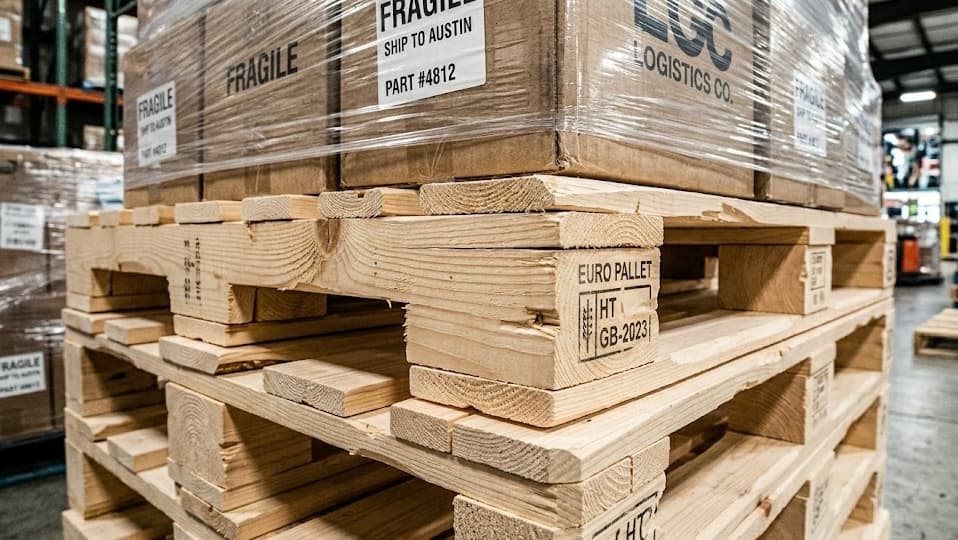
After treatment, pallets are cooled and stamped with the official IPPC mark that includes our facility identification number, the country code, and the HT treatment designation. This stamp is what customs inspectors look for.
Treatment Specifications
- Minimum Core Temperature
- 56°C (132.8°F)
- Minimum Hold Time
- 30 continuous minutes
- Treatment Code
- HT (Heat Treatment)
- Standard
- ISPM-15 / IPPC
- Monitoring
- Embedded core temperature probes
- Documentation
- Treatment certificate available
The IPPC Stamp and Certification
After heat treatment, every pallet receives the official IPPC (International Plant Protection Convention) mark. This stamp is recognized by customs authorities worldwide and serves as proof that the wood packaging material has been treated in accordance with ISPM-15 requirements.
The mark includes several key pieces of information: the IPPC logo (a wheat sheaf symbol), the two-letter country code (US for United States), a unique facility identification number assigned to SD Re Pallet by USDA APHIS, and the treatment code HT indicating heat treatment was applied.
The stamp must be applied to at least two opposite sides of the pallet and must be legible, permanent, and not capable of being transferred to another piece of packaging. We use industrial stenciling and branding methods to ensure stamps remain clear and readable throughout the pallet's service life.
Upon request, we also provide treatment certificates and documentation that you can include with your shipping papers for additional customs support. This documentation can be especially helpful for shipments to countries with stringent inspection regimes.
International Compliance
ISPM-15 compliance extends beyond just the pallets themselves. The standard applies to all wood packaging material in international trade, including crates, boxes, dunnage, and any sawn wood thicker than 6mm used to support or contain cargo.
We can heat-treat your existing pallets, manufacture new heat-treated pallets to your specifications, or provide heat-treated custom pallets and crating for oversized or specialty shipments. We also treat loose lumber, dunnage, and blocking material used in container loading.
For San Diego businesses that export regularly, we offer standing heat treatment programs where we maintain a supply of pre-treated pallets in your preferred sizes, ready for immediate delivery. This eliminates treatment lead time from your export preparation process. Visit our certifications page for details on our credentials and compliance standards.
Turnaround Times
Standard heat treatment turnaround is 2 to 3 business days from the time pallets are received at our facility. For rush orders, we offer next-day treatment subject to kiln availability.
If you are ordering new pallets with heat treatment, add 3 to 5 business days for manufacturing plus 2 to 3 days for treatment. For the fastest turnaround, order pre-treated pallets from our existing stock.
Pricing
Heat treatment is priced per pallet with volume discounts for larger batches. The fee covers the treatment process, temperature monitoring and documentation, and the official IPPC stamp.
Treatment can be performed on your existing pallets (bring them to us or we pick up) or applied to new pallets purchased from us. Bundling heat treatment with a new pallet order typically offers the best total value. Contact us for specific pricing.
ISPM-15 Compliance Requirements by Country
While ISPM-15 is a global standard, enforcement strictness and additional requirements vary by country. Here is what San Diego exporters need to know for key destinations.
| Country / Region | ISPM-15 Required | Enforcement Level | Additional Requirements | MB Fumigation Accepted |
|---|---|---|---|---|
| Mexico | Yes | High | None beyond standard | Yes (but HT preferred) |
| Canada | Yes | High | CFIA inspection at border | Yes |
| European Union (all members) | Yes | Very High | Strict stamp legibility checks | Being phased out |
| China | Yes | Very High | Additional quarantine inspections common | Yes |
| Japan | Yes | High | MAFF inspection at port of entry | Yes (limited) |
| Australia / New Zealand | Yes | Strictest globally | Bark-free requirement, biosecurity inspections | No (HT only) |
| South Korea | Yes | High | Phytosanitary certificate may be requested | Yes |
For shipments to Australia and New Zealand, we recommend heat treatment plus bark removal to avoid delays at customs. We can advise on specific requirements for any destination. Contact us with your target country and we will ensure your wood packaging meets all requirements.
Treatment Facility Technical Specifications
Kiln Specifications
Kiln Type
Industrial forced-air convection heat treatment kiln
Capacity Per Cycle
Up to 200 standard 48x40 pallets per batch
Temperature Range
Ambient to 90°C (194°F) maximum
Total Cycle Time
6-12 hours (ramp-up, hold, cool-down)
Daily Throughput
Up to 400 pallets per day (2 cycles)
Monitoring Equipment
Temperature Probes
8 embedded core temperature probes per load, placed in thickest wood members
Data Logger
Continuous digital recording at 1-minute intervals throughout treatment cycle
Calibration
Probes calibrated quarterly per USDA APHIS requirements
Records Retention
Treatment logs retained for 3 years minimum, available for customer audit
Alarm System
Automated alert if any probe fails to reach target temperature
Understanding the IPPC Certification Mark
The IPPC mark is the internationally recognized stamp that customs inspectors look for. Here is a breakdown of what each element means and where it appears on the pallet.
Mark Components (Left to Right)
IPPC Symbol
Wheat sheaf logo identifying the mark as an official IPPC-regulated stamp
Country Code
Two-letter ISO code for the country where treatment was performed
Facility ID
Unique number assigned to our facility by USDA APHIS
Treatment Code
HT = Heat Treatment. DB = Debarked (may appear alongside HT)
The mark is applied to at least two opposite sides of every treated pallet using industrial-grade stenciling or hot branding. We use both methods depending on the pallet type and customer preference. Hot branding produces a permanent mark that cannot fade or wear off. Stenciling is faster and equally acceptable under ISPM-15 regulations.
Stamps must be clearly legible, durable, and non-transferable. A common reason for customs rejection is stamps that have faded, been painted over, or are placed on removable components. We stamp directly on the stringer or main frame member to ensure permanence.
Common Mistakes Exporters Make with Wood Packaging
Using untreated pallets for export
The most common and costly mistake. Shipments are held at customs, quarantined, or destroyed. Always verify the HT stamp before loading export containers.
Repairing treated pallets with untreated lumber
If you replace boards on a heat-treated pallet with untreated wood, the entire pallet loses its ISPM-15 compliance. Replacement boards must also be heat treated.
Stamp placement on removable components
Stamps on deck boards that might be replaced during the pallet life cycle can render the mark invalid. Stamps should be on stringers or permanent frame members.
Assuming domestic pallets are export-ready
Standard recycled pallets used for domestic shipping are not heat treated unless specifically ordered that way. Never assume a pallet is compliant without verifying the stamp.
Forgetting about dunnage and blocking
ISPM-15 applies to ALL wood packaging material, not just pallets. Blocking, bracing, dunnage, and crating wood all require treatment if they are thicker than 6mm.
Relying on old treatment certificates
Treatment is applied to the pallet itself (via stamp), not documented separately for customs purposes. A certificate without a stamp on the wood will not satisfy inspectors.
Heat Treatment vs. Methyl Bromide Fumigation
Both methods are approved under ISPM-15, but they differ significantly in cost, environmental impact, and global acceptance.
| Factor | Heat Treatment (HT) | Methyl Bromide (MB) |
|---|---|---|
| Method | Kiln heating to 56°C core for 30 min | Chemical gas fumigation |
| Environmental impact | None (zero chemical residue) | Ozone-depleting substance |
| Global acceptance | Accepted worldwide, no restrictions | Banned or restricted in EU, Australia, NZ, Canada |
| Food-contact safe | Yes | Chemical residue concerns |
| Worker safety | No chemical exposure risk | Toxic gas, requires PPE and ventilation |
| Treatment duration | 6-12 hours per batch | 24-72 hours per batch |
| Future viability | Industry standard going forward | Being phased out globally under Montreal Protocol |
SD Re Pallet uses heat treatment exclusively. It is the safer, more environmentally responsible, and more universally accepted method. We strongly recommend heat treatment for all export wood packaging regardless of destination.
Exporting From San Diego?
Make sure your wood packaging meets ISPM-15 requirements. Contact us for heat treatment services, pre-treated pallets, or export packaging consultation.
Get StartedFrequently Asked Questions
Are your pallets fully ISPM-15 compliant?
Yes. We heat-treat to ISPM-15 standards, stamp pallets, and keep kiln records for audits.
Do you provide certificates with shipments?
Every heat-treated order includes a treatment certificate and stamp details for customs.
What sizes can you heat-treat?
Most common sizes including 48x40, 42x42, 48x48, and custom builds that fit our chambers.
How long does heat treatment take?
Standard runs complete within 24–48 hours. Rush same-day cycles are available for small batches.
Is fumigation used in your process?
No. We use heat treatment only—no chemical fumigation—meeting ISPM-15 requirements.
Can you re-stamp customer-supplied pallets?
We can heat-treat and stamp your pallets after inspection to confirm they meet structural requirements.
Do you track kiln batch numbers?
Yes. We log batch numbers, dates, and temperatures and can reference them for compliance inquiries.
Will heat treatment affect pallet strength?
Properly treated pallets maintain structural integrity; we inspect and reject any units that show damage.
Can you combine heat treatment with branding or stenciling?
Yes. We can add stencils or labels after treatment so markings remain legible for customs.
Do you offer storage of treated pallets?
We can store treated inventory short term and ship on call to align with your export schedule.