Euro Pallet Sizes
Full specifications for the EPAL EUR pallet family — the backbone of European logistics used by over 500 million pallets in circulation across the continent.
Order Euro Pallets
We supply EUR 1 and EUR 2 pallets for export and domestic use. Available new, recycled, and ISPM-15 certified.
What Is a Euro Pallet?
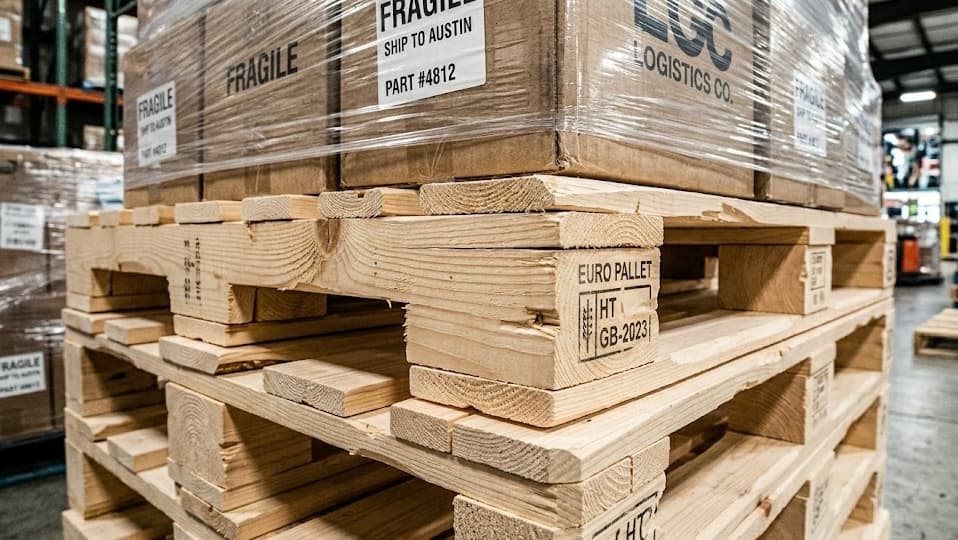
The Euro pallet, formally designated as the EUR pallet or EPAL pallet, is the standard shipping platform used across the European Union and much of the broader European Economic Area. Managed by the European Pallet Association (EPAL), this system defines six pallet sizes (EUR 1 through EUR 6), each with strict construction specifications, quality standards, and a unique branding and licensing framework that ensures consistency across manufacturers in over 30 countries.
The most common Euro pallet is the EUR 1, measuring 1200×800 mm (approximately 47.24×31.50 inches). It is a four-way entry block pallet with nine hardwood blocks, 11 deck boards (7 on top, 4 on the bottom), and 78 nails. Approximately 500 to 600 million EUR 1 pallets are currently in circulation across Europe, making it one of the most produced single pallet designs in the world.
Unlike the North American GMA system, which is more of a de facto industry standard, the EUR pallet operates within a formalized exchange pool. Licensed EUR pallets can be exchanged one-for-one at any point in the supply chain — a full pallet is traded for an empty one — eliminating the need for pallet return logistics. This pool system is one of the reasons European logistics costs per pallet trip are often lower than comparable North American costs.
Complete EUR 1 Through EUR 6 Specifications
Each EUR designation serves a different logistics segment. The EUR 1 is the standard general-purpose pallet, while the others address specific cargo, container, or display requirements. This is the most detailed EUR specification table available, covering every dimension, weight, and load rating.
| Type | mm (L × W) | Inches | Height | Weight | Dynamic Load | Static Load | Racking Load | Top Boards | Bottom Boards | Nails | Blocks |
|---|---|---|---|---|---|---|---|---|---|---|---|
| EUR 1 | 1200 × 800 | 47.24 × 31.50 | 144 mm (5.67″) | 25 kg (55 lbs) | 1,500 kg (3,307 lbs) | 4,000 kg (8,818 lbs) | 1,000 kg (2,205 lbs) | 7 | 4 (3 narrow + 1 wide) | 78 | 9 |
| EUR 2 | 1200 × 1000 | 47.24 × 39.37 | 162 mm (6.38″) | 33 kg (73 lbs) | 1,250 kg (2,756 lbs) | 4,000 kg (8,818 lbs) | 1,000 kg (2,205 lbs) | 7 | 5 | 98 | 9 |
| EUR 3 | 1000 × 1200 | 39.37 × 47.24 | 156 mm (6.14″) | 29 kg (64 lbs) | 1,500 kg (3,307 lbs) | 4,000 kg (8,818 lbs) | 1,000 kg (2,205 lbs) | 7 | 5 | 84 | 9 |
| EUR 4 | 800 × 600 | 31.50 × 23.62 | 144 mm (5.67″) | 9.5 kg (21 lbs) | 500 kg (1,102 lbs) | 1,340 kg (2,954 lbs) | — | 5 | 3 | 36 | 9 |
| EUR 5 | 600 × 400 | 23.62 × 15.75 | 78 mm (3.07″) | 5 kg (11 lbs) | 250 kg (551 lbs) | 500 kg (1,102 lbs) | — | 4 | 2 | 18 | 4 |
| EUR 6 | 800 × 600 | 31.50 × 23.62 | 144 mm (5.67″) | 9.5 kg (21 lbs) | 500 kg (1,102 lbs) | 2,000 kg (4,409 lbs) | 500 kg (1,102 lbs) | 5 | 3 | 42 | 9 |
EUR 4 and EUR 5 are half-pallet and quarter-pallet sizes primarily used for retail display and point-of-sale applications. EUR 6 is dimensionally identical to EUR 4 but built to a heavier specification for racking applications. All EUR pallets use block construction with true 4-way fork entry.
EUR 1 Construction in Detail
The EUR 1 pallet is a block pallet, meaning it uses nine solid wood blocks (three rows of three) as its support structure instead of the continuous stringers used in GMA pallets. Block construction enables true four-way forklift entry from any side without the notching required on stringer pallets, making block pallets faster to handle in high-throughput environments.
The top deck consists of five full-length boards and two narrower end boards, totaling seven boards across the 1200 mm length. The bottom deck uses three boards positioned under each row of blocks. All boards and blocks are connected with exactly 78 special spiral nails specified by EPAL. The wood must be solid hardwood or softwood (not particle board or engineered wood), and each board must be free of bark, rot, and damage that would compromise structural integrity.
Official EUR pallets carry multiple stamps and markings. The EPAL oval stamp appears on the center blocks, indicating the pallet was manufactured by a licensed EPAL producer. The EUR marking on the left block confirms the pallet meets the UIC 435-2 standard. A production code identifies the manufacturer, the year of production, and the country of origin. These markings are critical for the exchange pool system — pallets without proper stamps cannot be exchanged and are treated as one-way or white-wood pallets.
EPAL Quality Marks: How to Read Euro Pallet Stamps
Every authentic EUR pallet carries a specific set of branding marks burned or stamped into the wood blocks. These marks serve as quality certificates, traceability codes, and pool membership indicators. Learning to read them is essential for quality inspection, pallet purchasing, and exchange pool participation.
EPAL Oval Mark
Location: Center block on both sides of the pallet
The EPAL oval is the primary authentication mark. It indicates the pallet was manufactured or repaired by an EPAL-licensed facility. The oval contains “EPAL” in the upper half and is bordered by a distinctive shape. Pallets without this mark cannot participate in the European exchange pool.
EUR Mark
Location: Left block (when viewed from the long side)
The EUR designation (EUR 1, EUR 2, etc.) identifies the pallet type and confirms compliance with UIC 435-2 specifications. This mark has been used since the original European railway pallet standard was established. Both EUR and EPAL marks are required for full exchange pool eligibility.
Producer Code
Location: Right block
A numeric code identifying the licensed manufacturer. The first two characters indicate the country (e.g., DE for Germany, FR for France, PL for Poland). The remaining digits identify the specific production facility. This code enables full traceability back to the manufacturer.
Production Year / Month
Location: Burned into block, often near producer code
Indicates when the pallet was manufactured. Format varies: some use MM-YY, others use a coded month and two-digit year. This is useful for estimating pallet age and remaining service life. EPAL pallets typically last 6-10 years in the pool with repairs.
Repair Mark (Nail Symbol)
Location: Center block, adjacent to EPAL oval
When a pallet is repaired by a licensed repair facility, a nail-shaped stamp is added next to the EPAL oval. Multiple repair marks may be present. A pallet can be repaired an unlimited number of times as long as it meets dimensional and structural criteria after each repair.
IPPC / ISPM-15 Mark
Location: Any block, typically the center
The wheat-sheaf IPPC symbol confirms the pallet wood has been heat treated (HT) or methyl bromide treated (MB) in compliance with the International Standards for Phytosanitary Measures No. 15. Required for all pallets used in international trade to prevent pest transmission.
EUR Pallet Repair Standards and Requirements
One of the strengths of the EPAL system is its formalized repair protocol. Damaged pallets do not leave the pool permanently; instead, they are repaired by licensed facilities and returned to circulation. This extends the average lifespan of a EUR pallet to 6-10 years and dramatically reduces waste.
Repair eligibility criteria:A EUR pallet can be repaired as long as the blocks are intact (no splits deeper than 1/3 of block thickness), no more than 2 top deck boards and 1 bottom deck board need replacement, and the overall dimensional tolerance remains within ±3 mm of the original specification. Pallets that exceed these damage thresholds must be recycled rather than repaired.
Material requirements for repairs: Replacement boards must match the original dimensions exactly. EPAL specifies that replacement nails must be the same spiral type as originals, driven at the same angles. New boards must be free of bark, blue stain exceeding 10% of the board surface area, and any rot or insect damage. Knot diameter must not exceed 1/3 of the board width.
Repair marking:After a successful repair, the repair company stamps a nail-shaped mark adjacent to the EPAL oval on the center block. The repairer’s license number is also branded onto the pallet. This provides full traceability for every repair event in the pallet’s history.
Quality audits: EPAL repair licensees undergo the same annual quality audits as production licensees. An independent auditor checks a random sample of repaired pallets for dimensional accuracy, board quality, nail type, and marking compliance. Facilities that fail audits risk losing their repair license.
European Pallet Pooling Systems Comparison
While the EPAL exchange pool is the largest open pool in Europe, several private and semi-private pooling systems also operate on the continent. Each system has different cost structures, quality levels, and geographic coverage.
| Feature | EPAL Open Pool | CHEP Europe | LPR (La Palette Rouge) | IPP Logipal |
|---|---|---|---|---|
| Pool Type | Open exchange (one-for-one swap) | Closed rental (issue & return) | Closed rental | Closed rental |
| Pallet Color | Natural wood | Blue | Red | Natural wood / branded |
| Primary Size | 1200 × 800 mm | 1200 × 800 mm | 1200 × 800 mm | 1200 × 800 mm |
| Pool Size | 500-600 million | 120+ million (Europe) | 80+ million | 30+ million |
| Cost Model | Purchase pallet; exchange free | Per-issue rental fee + transfer fee | Per-issue rental fee | Per-issue rental fee |
| Initial Cost | €7-15 per pallet (purchase) | €0 (rental) | €0 (rental) | €0 (rental) |
| Per-Trip Cost | €0 (exchange is free) | €3.50-6.00 | €3.00-5.50 | €3.00-5.00 |
| Lost Pallet Fee | Cost of replacement | €20-30 | €18-25 | €15-22 |
| Geographic Coverage | 30+ countries (EU + UK) | 25+ European countries | 15+ European countries | 10+ European countries |
| Best For | High-volume, open supply chains | Closed-loop retail / FMCG | France, UK, Benelux focus | Germany, Central Europe |
EPAL Licensing: Costs and Requirements
Manufacturing or repairing EUR pallets requires an EPAL license. Licensed producers undergo annual audits to verify compliance with construction specifications, wood quality standards, and nail type requirements. Only pallets produced by licensed manufacturers may carry the EUR and EPAL stamps.
There are three categories of EPAL licensing:
Production License
Authorizes the manufacturer to build new EUR pallets from raw lumber. Requires dedicated production equipment, quality control processes, and annual inspection by an accredited third-party auditor.
Typical Costs:
- Application fee: €800 - €1,200
- Annual license fee: €1,500 - €3,000
- Annual audit cost: €1,000 - €2,000
- Branding iron set: €200 - €500
Repair License
Permits a facility to repair damaged EUR pallets and return them to the exchange pool. Repaired pallets must meet the same dimensional and structural standards as new pallets. Repair nails must be the same EPAL-specified type.
Typical Costs:
- Application fee: €500 - €800
- Annual license fee: €1,000 - €2,000
- Annual audit cost: €800 - €1,500
- Repair branding iron: €150 - €300
ISPM-15 Stamp
EUR pallets used in international trade must also bear the IPPC ISPM-15 heat treatment stamp. This confirms the wood has been heated to a core temperature of 56°C for 30 minutes to eliminate wood-boring pests.
Typical Costs:
- Registration with national plant protection org
- Heat treatment kiln certification
- Annual audit: €500 - €1,000
- Per-pallet HT cost: €0.50 - €1.50
How to Detect Counterfeit Euro Pallets
Counterfeit EUR pallets are a significant problem in the European logistics market. Estimates suggest that 5-10% of pallets carrying EUR/EPAL markings are counterfeits — pallets that were not produced by licensed manufacturers and may not meet the quality and safety standards of genuine EPAL pallets. Using counterfeit pallets risks product damage, workplace injuries, and exchange pool rejection.
1. Check the EPAL Oval Mark Quality
Genuine EPAL marks are burned into the wood using a professional-grade branding iron. The oval should be crisp, evenly burned, and clearly legible. Counterfeit marks are often stamped with ink (which smudges and fades), hand-painted, or burned with a poorly made iron that produces blurry, uneven lettering. If the EPAL text is fuzzy, off-center within the oval, or inconsistent in depth, the pallet is likely counterfeit.
2. Verify the Producer Code
Every licensed EPAL producer has a unique numeric code. You can verify producer codes through the EPAL website’s online database. If the code on the pallet does not match any registered producer, or if the country prefix does not correspond to where the pallet appears to have been made, it is a counterfeit.
3. Count the Nails
A genuine EUR 1 pallet has exactly 78 nails. Counterfeit pallets frequently use fewer nails (sometimes as few as 40-50) to reduce manufacturing costs. The nails should be spiral or ring-shank type. If you see smooth-shank nails, the pallet is either counterfeit or was poorly repaired.
4. Measure the Blocks
EUR 1 blocks must be 145 mm × 145 mm × 78 mm (±2 mm). Corner blocks are 145 mm × 100 mm × 78 mm. Counterfeit pallets often use blocks that are slightly undersized (cheaper to produce) or cut from scrap wood with visible defects. Measure a few blocks with a tape measure; deviations of more than 3 mm from specification indicate a counterfeit.
5. Inspect Board Quality
Genuine EPAL boards must be free of bark, significant blue stain (max 10% of surface), rot, and worm damage. Board dimensions must be within ±2 mm of specification. Counterfeit pallets frequently use rough-sawn boards of inconsistent thickness, boards with bark edges, or boards that are visibly thinner than the 22 mm standard.
6. Check Chamfered Edges
Genuine EUR 1 pallets have chamfered (beveled) edges on the top lead boards and bottom end boards. The chamfer helps fork tines slide under the pallet smoothly. Counterfeit pallets often lack chamfers or have rough, uneven bevels.
When Should You Use Euro Pallets?
Euro pallets are the right choice in several common scenarios. The most obvious is exporting goods to Europe. If your products are destined for a European warehouse, distribution center, or retail operation, shipping on EUR 1 pallets saves your customer the cost and labor of re-palletizing your goods onto local pallets upon arrival. European dock workers, forklifts, racking systems, and automated handling equipment are all sized for EUR 1 dimensions — arriving on a 48×40 GMA pallet means your goods will not fit standard European infrastructure.
Euro pallets also make sense when you participate in the EPAL exchange pool. Companies that trade within Europe can exchange loaded EUR pallets one-for-one at each transfer point, dramatically reducing empty pallet return logistics and simplifying pallet accounting. The pool effectively functions as a currency — one standard-quality EUR pallet equals one standard-quality EUR pallet, regardless of who manufactured it.
Some U.S. importers prefer Euro pallets for receiving goods from European suppliers. Rather than requiring the European shipper to re-palletize onto GMA pallets before export, the importer accepts EUR pallets and either uses them internally, resells them to other importers, or returns them to the EPAL pool through a licensed partner.
Finally, some domestic operations choose Euro pallets for their superior block construction. The nine-block design provides true four-way forklift entry, which can speed up handling in tight warehouse spaces where stringer pallets (which only allow full fork entry from two sides) create bottlenecks.
Euro Pallet vs American GMA Pallet
The two most common pallets in the world serve different markets. Here is a detailed side-by-side comparison.
| Attribute | EUR 1 (Euro) | GMA (48×40) |
|---|---|---|
| Dimensions | 1200 × 800 mm | 1219 × 1016 mm |
| Footprint Area | 0.96 m² (10.33 sq ft) | 1.24 m² (13.33 sq ft) |
| Construction | Block (9 blocks) | Stringer (3 stringers) or block |
| Fork Entry | True 4-way | 4-way with notched stringers |
| Pallet Weight | 25 kg (55 lbs) | 15-22 kg (33-48 lbs) |
| Dynamic Load | 1,500 kg (3,307 lbs) | 1,134-1,270 kg (2,500-2,800 lbs) |
| Exchange Pool | Yes (EPAL licensed) | No formal pool |
| Quality Control | EPAL-audited annually | Manufacturer-dependent |
| Per 53' Trailer | 26 pallets on floor | 20 pallets on floor |
| Avg. New Cost (US) | $15 - $30 | $11 - $25 |
Need both sizes? SD Re Pallet supplies GMA and Euro pallets from the same facility. See our full comparison chart for additional standards.
Need Euro Pallets in California?
SD Re Pallet supplies EUR 1 and EUR 2 pallets for export operations, European-standard warehouses, and the EPAL exchange pool. New and recycled options available.
Request a Euro Pallet Quote